Rassvet Mini-Research Module 1 (MRM-1)
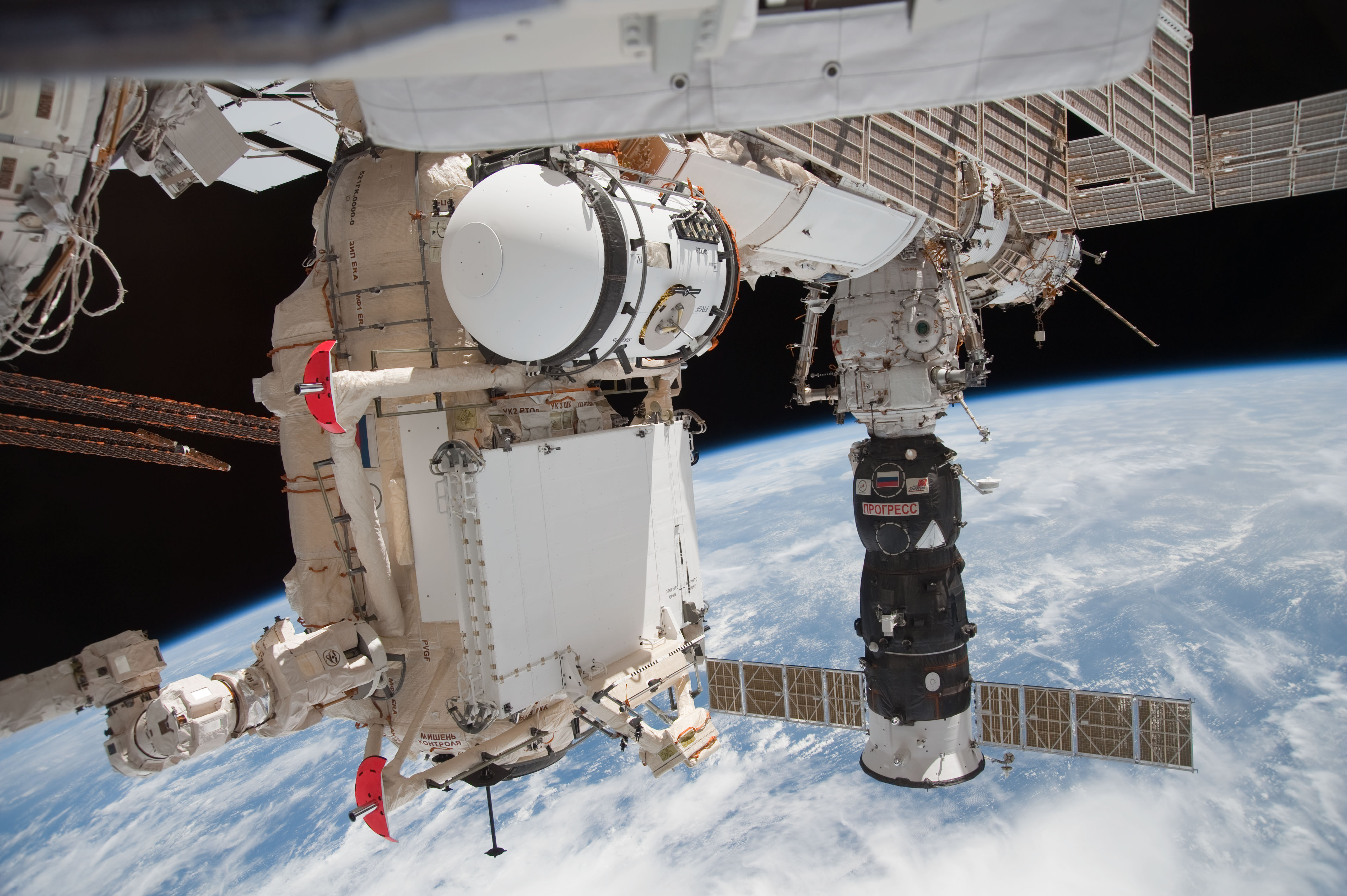
About Rassvet
Rassvet — Russian for "dawn" — is a component of the International Space Station's Russian Orbital Segment, designated Mini-Research Module 1 (MRM-1) and operated by Roscosmos. Compact by ISS standards, it serves a combination of roles: providing an active docking interface for visiting Russian spacecraft, supporting cargo stowage, and enabling a modest program of scientific research. Rassvet was launched on 14 May 2010 aboard Space Shuttle Atlantis during mission STS-132, making it an unusual case of a Russian segment element delivered by an American vehicle. It remains attached to the station and operational, tracked as part of the ISS under NORAD catalog number 25544 rather than as a separately catalogued object.
Purpose and Role
Rassvet's primary operational function is to serve as a docking port for Soyuz crewed spacecraft and uncrewed Progress resupply vehicles. Within the architecture of the ISS Russian Orbital Segment, maintaining multiple compatible docking interfaces is an essential logistical requirement. Soyuz vehicles rotate regularly as crew transport ships, and Progress vehicles arrive multiple times per year with propellant, water, food, and equipment. Each of these spacecraft must have a designated berth, and Rassvet contributes one such interface to that network, broadening the station's ability to accommodate visiting vehicles without monopolizing ports needed by other segments or modules.
Beyond its docking function, Rassvet provides storage volume for cargo. Space aboard any orbital outpost is a finite and carefully managed resource, and even a compact module can meaningfully offset the stowage burden carried by larger nodes and laboratories. Crews make use of whatever internal volume is available, and a module attached at the edge of the Russian segment that can hold equipment, supplies, or experiment hardware reduces congestion elsewhere on the station.
The module also supports scientific research, though this is a secondary rather than a primary role. Microgravity provides conditions that are essentially impossible to replicate on Earth's surface at any meaningful scale: the near-elimination of buoyancy-driven convection, the ability to process materials in sustained weightlessness, and a platform in low Earth orbit that allows Earth observation and exposure experiments. Research activities conducted in or through Rassvet fit into this broader ISS science program, contributing to the Russian segment's experimental output without requiring a dedicated large laboratory volume.
Launch and Assembly
The delivery of Rassvet to the ISS came during STS-132, the final scheduled flight of Space Shuttle Atlantis before that orbiter's retirement, which launched on 14 May 2010. The choice of a Space Shuttle as the delivery vehicle for what is fundamentally a Russian segment element reflects a distinctive chapter in the history of the station's assembly: a formal hardware exchange arrangement between NASA and Roscosmos that saw American launch capacity used in service of Russian infrastructure additions.
Under this arrangement, NASA used the Shuttle's large cargo bay — a volume no Russian launch vehicle could match for awkwardly shaped or sizable payloads — to carry Rassvet to the station. In exchange, Russia provided hardware and services that benefited the American side of the partnership. The negotiation and execution of such cross-agency deals illustrate how the ISS program, often discussed in terms of its science output, also operates as a complex ongoing exercise in international resource management.
The actual installation process relied on the station's robotic systems and the coordination of crewmembers aboard both the orbiter and the station. Rassvet was berthed to the Earth-facing, or nadir, port of the Zarya module — the Functional Cargo Block that was itself the very first element of the ISS launched into orbit in 1998. Zarya, also Russian in origin and located at the core of the Russian Orbital Segment, thus became the structural attachment point that physically anchors Rassvet to the broader station assembly. The connection placed Rassvet in a position well-suited for docking operations with approaching Soyuz and Progress vehicles.
The use of Space Shuttle Atlantis for this delivery is historically notable beyond the bilateral arrangement itself. Atlantis carried Rassvet tucked into its payload bay alongside other cargo, and the mission followed the established pattern of Shuttle assembly flights: rendezvous with the station, crew transfer, robotic arm operations to extract and position the new element, extravehicular activities to complete installation tasks, and departure once work was complete. STS-132 thus stands as a moment at which the American Shuttle program directly expanded the Russian portion of the station in its closing years of operation.
Design and Configuration
Because no specific mass, dimensional, or internal rack figures are part of the verified record available here, Rassvet is best characterized in functional and contextual terms rather than precise engineering ones. It belongs to the family of smaller Russian modules sometimes referred to as mini-research modules, a category distinct from the large multipurpose laboratory modules or the big functional blocks that form the backbone of the Russian segment. Its scale is suited to its purpose: rather than housing a full science laboratory or serving as a major habitable node, it provides a focused set of capabilities — a docking port, stowage volume, and research accommodation — in a relatively compact form.
The docking port it carries is of the type compatible with the standard docking systems used by Soyuz and Progress spacecraft, both of which have flown in evolved but recognizable forms for decades. This compatibility is not incidental; standardization of docking interfaces across the Russian fleet is a deliberate engineering philosophy that simplifies operations, reduces the risk of incompatibility, and allows flexibility in assigning vehicles to ports as mission needs change.
Internally, the module provides the pressurized environment that crew members can enter, work in, and use for stowage or research tasks. Like all pressurized ISS modules, it is maintained at a shirt-sleeve atmosphere, meaning astronauts and cosmonauts do not require pressure suits to move through it. The structural connection to Zarya means Rassvet is accessible from within the station without requiring any extravehicular activity for normal operations.
Significance and Current Status
Rassvet occupies a small but genuine place in the record of ISS assembly. It was among the later modules added to a station that was, by 2010, approaching completion of its primary assembly sequence. Its addition expanded the Russian Orbital Segment's docking capacity and stowage resources at a stage when the station was preparing to operate at full crew complement and maximum scientific productivity.
The circumstances of its launch — carried by a Space Shuttle as part of a bilateral hardware exchange — make it something of an anomaly in the assembly history. Most Russian segment elements arrived on Russian rockets, and most Shuttle flights served the American, European, or Japanese portions of the station. Rassvet crossed that informal boundary in a concrete way, physically embodying the cooperative framework that underpins the entire ISS project. The station is often cited as a model of international partnership in space, and Rassvet's delivery is a tangible, hardware-level example of what that partnership can produce: one partner's transportation system placing another partner's module in orbit when that was the practical solution.
As of current operations, Rassvet remains attached to the ISS and functional. It continues to provide docking services for the Soyuz and Progress vehicles that are essential to keeping the station crewed and supplied. It is tracked as part of the ISS assembly under NORAD catalog number 25544, consistent with the treatment of all station modules, which are monitored as a single complex in low Earth orbit rather than as individually catalogued objects. The station maintains an orbital altitude of roughly 408 kilometers at an inclination of 51.6 degrees, parameters that reflect both the engineering requirements of the ISS and the latitude of Baikonur Cosmodrome, from which Russian crew and cargo vehicles launch to reach it.
In the longer term, Rassvet's fate is tied to that of the ISS itself. Planning for the station's eventual deorbit and for successor platforms continues, but for the present operational period Rassvet remains a working element of an active orbital laboratory, doing the quiet, essential work that functional infrastructure always does: making the larger enterprise possible.
Part of the International Space Station. The station is tracked as one object — track the ISS live.