Pirs Docking Compartment (DC-1)
About Pirs
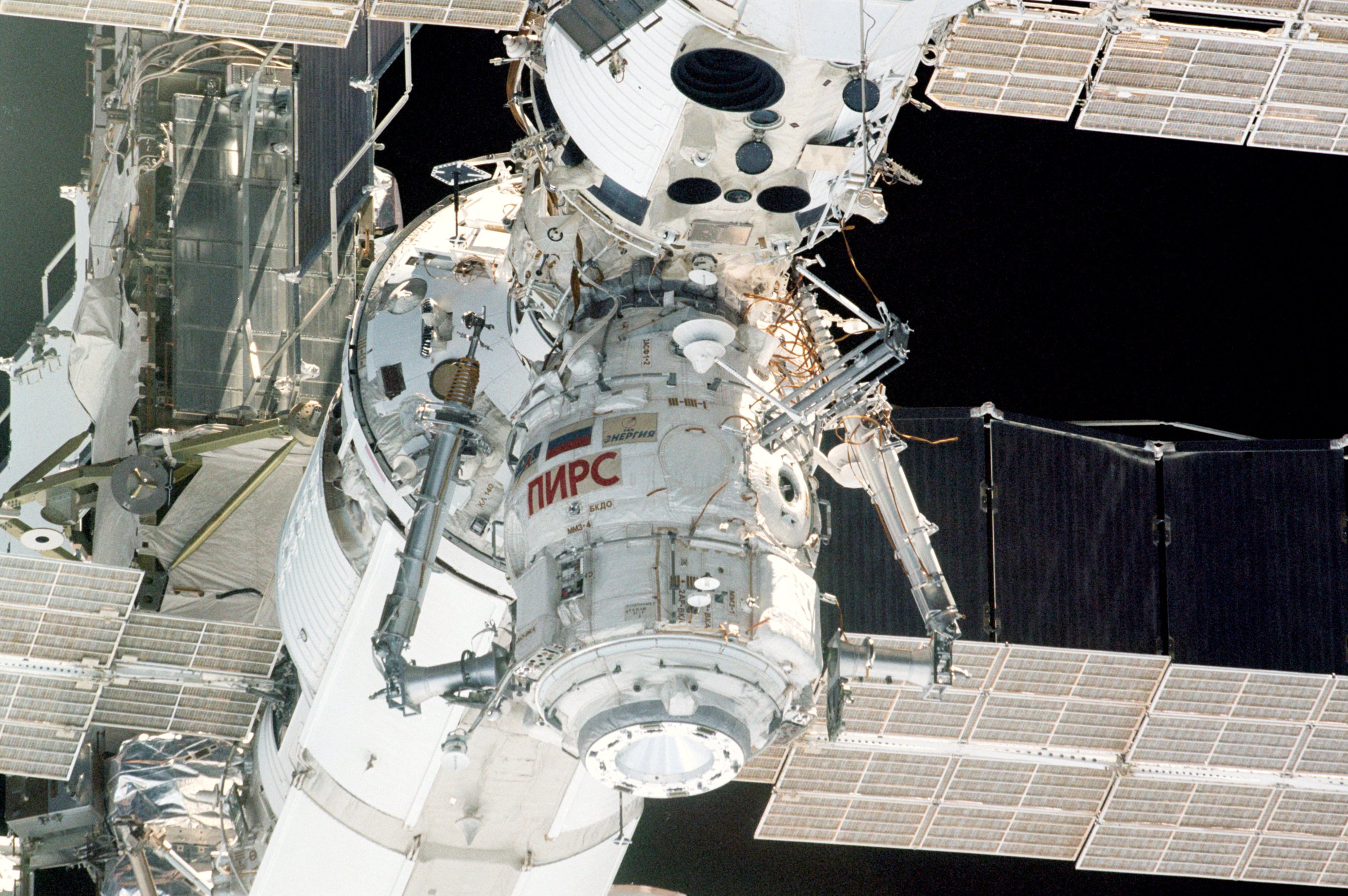
Pirs was a compact pressurised module of the International Space Station's Russian Orbital Segment, operated by Roscosmos and serving the station for nearly twenty years before becoming the only ISS pressurised module ever to be deliberately removed and destroyed on reentry. Its name is the Russian word for "pier," a fitting designation for a structure whose central purpose was to provide a point of attachment — for visiting spacecraft, for spacewalking cosmonauts, and by extension for the ongoing human presence the station depends upon. Launched in September 2001 and deorbited in July 2021, Pirs occupies a distinct place in the history of the ISS: a module whose end of life was as deliberate and logistically significant as its beginning.
Purpose and Role
From the moment it was integrated into the station, Pirs performed two functions that were operationally inseparable from the rhythm of Russian spaceflight operations at the ISS. The first was docking: Pirs provided a dedicated berthing port compatible with both Soyuz crewed spacecraft and Progress uncrewed cargo vehicles, the workhorses of Russian ISS logistics. Without reliable docking infrastructure, crew rotation and resupply — the two activities that make continuous human occupation of a space station possible — would require improvised solutions. Pirs removed that uncertainty by offering a port specifically configured for these vehicles, allowing mission planners to schedule arrivals and departures against a stable, well-understood interface.
The second function was extravehicular activity (EVA) support. Pirs served as an airlock for spacewalks conducted by cosmonauts wearing the Russian Orlan suit. An airlock's role is straightforward but critical: it allows crew members to transition between the pressurised interior of the station and the vacuum of space without venting the main habitable volume to the outside. In practice, this means the airlock must be capable of depressurisation and repressurisation on a timeline compatible with EVA operations, and it must be sized and equipped to accommodate suited crew members and their tools. Pirs fulfilled this role for Russian-segment spacewalks throughout its service life, supporting dozens of Orlan-suit excursions over its two decades of operation. This made it not simply a passive structural element but an active enabler of the maintenance, repair, and scientific deployment work that sustains a station in low Earth orbit.
The two functions reinforced each other operationally. A module that could receive visiting spacecraft and serve as an EVA staging point reduced the demands placed on other parts of the station, gave the Russian segment a degree of self-sufficiency in conducting its activities, and provided redundancy in docking capacity alongside other available ports.
Launch and Assembly
Pirs launched on 14 September 2001 aboard a Soyuz-U rocket, delivered as the payload of a Progress spacecraft designated Progress M-SO1. This approach — using a modified Progress vehicle as both the launch adapter and the delivery mechanism — was a well-established method for transporting Russian ISS modules of this class, allowing the module to be manoeuvred autonomously to the station and docked without requiring Shuttle involvement. The use of the Soyuz-U, a reliable and extensively flown member of the Soyuz launch vehicle family, reflected the operational conservatism that characterised Russian ISS logistics planning.
Once at the station, Pirs was attached to the nadir port of the Zvezda Service Module, the core of the Russian Orbital Segment. "Nadir" refers to the direction pointing toward Earth, meaning Pirs extended from the Earth-facing side of Zvezda. This placement was geometrically deliberate: a nadir-facing docking port is well-positioned for the approach profiles used by Soyuz and Progress vehicles, and it situated Pirs in a location where it could function without interfering with the solar arrays and radiators that extend along the station's main truss. From this position, Pirs became a permanent fixture of the station's lower profile as seen from the ground, a small pressurised cylinder extending toward Earth at an orbital altitude of roughly 408 kilometres and an inclination of 51.6 degrees.
Pirs is not separately catalogued in orbital tracking databases. Like all components physically integrated into the ISS, it was tracked as part of the station under NORAD identifier 25544, the catalogue number assigned to the ISS itself.
Design and Interior
Pirs was a relatively modest structure by ISS standards, designed for function rather than habitable volume. Its interior was configured around the requirements of its two primary roles: accommodating crew members preparing for or returning from spacewalks, and providing the mechanical and atmospheric interfaces needed for docking operations. Modules of this type in the Russian segment are engineered to tight tolerances because the docking system must align precisely with the approach vehicles, and the airlock seals must hold reliably against the pressure differential between the habitable interior and the vacuum outside.
The Orlan suit, which Pirs was designed to support, is a semi-rigid suit that cosmonauts don by entering through a rear hatch in the suit's hard upper torso. This design has implications for the airlock's interior geometry: unlike the American EMU suit used with the Quest airlock on the US segment, the Orlan does not require a separate suit donning area in the same configuration, but the airlock still needs to be large enough to accommodate suited crew members and their pre-EVA preparations, including pressure checks and equipment configuration. Pirs was equipped with the necessary handrails, suit support hardware, and atmospheric control systems to manage this process.
As a docking compartment, Pirs also contained the probe-and-drogue or androgynous docking hardware compatible with Soyuz and Progress vehicles, along with the associated structural reinforcement required to absorb docking loads without transmitting damaging forces to the rest of the station. The interface between Pirs and Zvezda incorporated standard Russian docking system components, which is why the same nadir port could later be reused for a different module once Pirs was removed.
Decommissioning and Significance
After approximately twenty years of continuous service, Pirs was removed from the station in a process that was itself a significant logistical undertaking. On 26 July 2021, Pirs was undocked from Zvezda's nadir port and deorbited, burning up destructively during atmospheric reentry. The immediate purpose of this removal was to free the nadir port of Zvezda for the Nauka Multipurpose Laboratory Module, a large Russian addition to the station that required exactly the attachment point Pirs had occupied. The sequencing was precise: Pirs had to depart before Nauka could take its place.
The decommissioning of Pirs is without precedent in the history of the ISS. Every other module that has been part of the station remains attached to it; no other pressurised module has been intentionally separated and destroyed. This makes Pirs a singular case in the programme's history — not a failed component, not an emergency jettison, but a planned and controlled retirement executed because the station's evolving configuration required it. The decision reflected both the finite number of attachment points available on the Russian segment and the long-deferred ambition to add Nauka, a module that had been in development for many years before its eventual launch.
From a tracking and orbital mechanics standpoint, the removal of Pirs did not change the ISS's NORAD catalogue entry; the station continues to be tracked under identifier 25544. Pirs left no persistent orbital presence. Its hardware no longer exists in any recoverable form.
What Pirs represents, in retrospect, is the kind of infrastructure that space stations require but that rarely receives sustained attention: not a laboratory, not a habitation module, not a cupola with a commanding view, but a utilitarian junction point that made operations possible. Docking ports and airlocks are the connective tissue of a space station, and Pirs served that function reliably across two decades and through the tenures of many crews. Its removal was not a failure but a transition — a recognition that the station it had served had grown and changed enough to need something different in the place it had occupied.
Part of the International Space Station. The station is tracked as one object — track the ISS live.