Leonardo Permanent Multipurpose Module (PMM)
About Leonardo
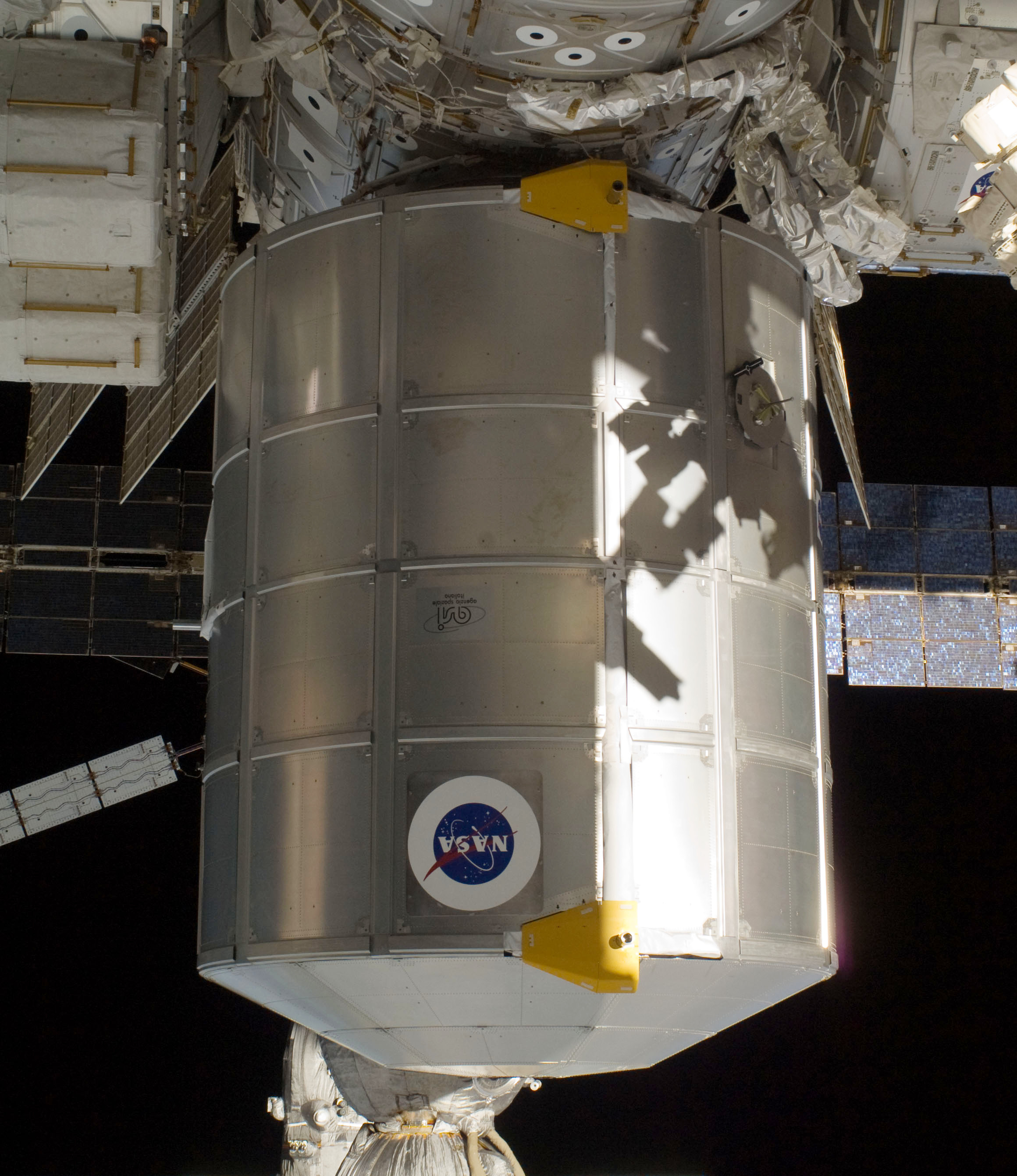
Leonardo, formally designated the Permanent Multipurpose Module (PMM), is a pressurized storage module attached to the International Space Station and operated jointly by NASA and the Italian Space Agency (ASI). Launched on 24 February 2011 aboard Space Shuttle Discovery during mission STS-133, it became a fixed part of the station's structure rather than returning to Earth as its predecessors had done. Leonardo is part of the US Orbital Segment, the collective term for the American and international-partner portions of the ISS, and it remains operational today. Because it is structurally integrated into the station, Leonardo is not tracked as a separate object; it shares the ISS catalog entry under NORAD identifier 25544.
Purpose and Role
Leonardo's primary function aboard the ISS is to serve as a large, pressurized internal storage facility. In that capacity it holds cargo, consumable supplies, spare hardware, and equipment that crews need ready access to but that does not require dedicated laboratory or habitability space. This kind of supplementary volume is essential on any long-duration space platform: as scientific equipment evolves, spare parts accumulate, and mission requirements shift, having a dedicated repository allows the active laboratory and habitation modules to remain focused on their core purposes rather than being consumed by stowage demands.
The module is berthed to the Unity node, one of the earliest American connecting hubs on the station. Unity acts as a junction between several sections of the ISS, and Leonardo's attachment there places it in a logistically convenient position within the station's internal layout, giving crew members relatively straightforward access without navigating through the full length of the complex. In microgravity, where orientation is essentially arbitrary and walls, floor, and ceiling all become usable surfaces, even a module dedicated to storage represents a substantial and usable volume of pressurized real estate.
Beyond passive storage, Leonardo contributes to the broader sustainability of the ISS by reducing the frequency with which consumables and spares must be delivered from Earth. A well-stocked internal module acts as a buffer, providing operational flexibility when resupply missions are delayed or when unexpected equipment failures require immediate access to replacement hardware. In this sense Leonardo functions less like a scientific instrument and more like a critical logistical backbone — unglamorous in concept but indispensable in practice.
Launch and Assembly
Leonardo's path to becoming a permanent station fixture is rooted in its earlier life as a reusable cargo carrier. Before its final flight, it belonged to a class of Italian-built logistics modules designed specifically for the Space Shuttle program. These modules were engineered to fit inside the Shuttle's payload bay and were flown up loaded with supplies, temporarily attached to the station for unloading and reloading with waste or returned equipment, and then brought back to Earth aboard the same or a subsequent Shuttle. They were workhorses of the ISS supply chain during the Shuttle era, cycling between the ground and orbit multiple times.
For its final mission, Leonardo was modified to make it suitable for permanent residency in orbit. Rather than functioning as a temporary visitor that would be detached and stowed in Discovery's cargo bay for the trip home, it was prepared structurally and outfitted to remain in space indefinitely. This required upgrades to ensure it could withstand the long-term thermal, radiation, and micrometeorite environment of low Earth orbit without the periodic refurbishment possible when a module returns to the ground.
STS-133, which lifted off on 24 February 2011, was the final flight of Space Shuttle Discovery and one of the last Shuttle missions overall. The crew delivered Leonardo to the station and, using the station's robotic arm systems, berthed it permanently to the Unity node. The mission marked a transition: Discovery, after a long career, was making its last journey, and one of its payloads was simultaneously beginning what amounts to an indefinite tour of duty. The convergence of Discovery's retirement and Leonardo's permanent installation gives STS-133 a particular weight in the history of the program.
Inside the Module
Leonardo is a cylindrical pressurized vessel, consistent with the general design language of the modules built for the ISS and its logistics support. The interior is fitted with standardized rack systems along its inner walls — the same general approach used throughout the station to maximize usable volume and allow modular reconfiguration of equipment and stowage. In microgravity, every surface of a cylindrical module is accessible, so racks and attachment points are distributed to exploit the full circumference rather than relying on a conventional floor-up arrangement.
The racks within Leonardo can accommodate a range of cargo containers and hardware packages. Some positions are suited for active equipment with power and data connections, while others serve as simple mechanical attachment points for passive stowage bags and containers. This flexibility means Leonardo is not locked into a single configuration; its contents and internal arrangement can evolve as mission needs change over the lifetime of the station.
Because the module is pressurized and connected to the rest of the ISS atmosphere, crew members can work inside it without spacesuits. Access is through a standard hatch interface, and once inside, astronauts can retrieve or stow items by hand. The environment is the same shirtsleeve atmosphere maintained throughout the habitable sections of the station, and the module is maintained at temperatures and humidity levels consistent with crew comfort and hardware preservation.
Although Leonardo is not a laboratory module, it would be misleading to characterize it as entirely passive. The spare hardware it holds often relates directly to the science and life-support systems elsewhere on the station, meaning its contents have a direct bearing on the research and operational continuity conducted in modules like the Destiny laboratory or the Columbus science module.
Significance and Current Status
Leonardo's significance has two dimensions: the historical and the operational. Historically, it represents the end point of an evolutionary arc in ISS logistics. The Italian-built logistics modules were among the most frequently flown large payloads of the late Shuttle era, and their conversion into a permanent installation symbolizes the maturation of the station from an assembly project into a settled, long-term outpost. What was once a ferry has become furniture.
Operationally, Leonardo continues to fulfill its storage role as of the current date, quietly supporting station activities without drawing the attention that accrues to modules where scientific experiments are conducted or where astronauts sleep and exercise. This operational invisibility is, in a sense, a mark of success: a storage module that works well is one that crews do not have to think about. The hardware is there when needed, the volume is accessible, and the module integrates seamlessly into the daily logistics of a facility that has been continuously inhabited since the year 2000.
The ISS as a whole orbits at an inclination of approximately 51.6 degrees to the equator at an altitude in the vicinity of 408 kilometers, completing roughly sixteen orbits of Earth per day. Leonardo shares that trajectory as an inseparable part of the structure, and because it is not independently catalogued, observers and tracking systems treat it as part of the single object represented by NORAD 25544. Any ground-based tracking or pass prediction for the ISS therefore encompasses Leonardo as well.
Looking forward, Leonardo's role will continue to be shaped by the evolving logistics demands of the station and, ultimately, by decisions about the ISS's operational lifetime. As long as the station flies, a dedicated pressurized storage volume remains a practical necessity, and Leonardo is well positioned to continue meeting that need. Its transition from a returnable cargo carrier to a permanent module was a deliberate architectural decision, and the years since STS-133 have validated that choice.
Part of the International Space Station. The station is tracked as one object — track the ISS live.