Harmony (Node 2)
About Harmony
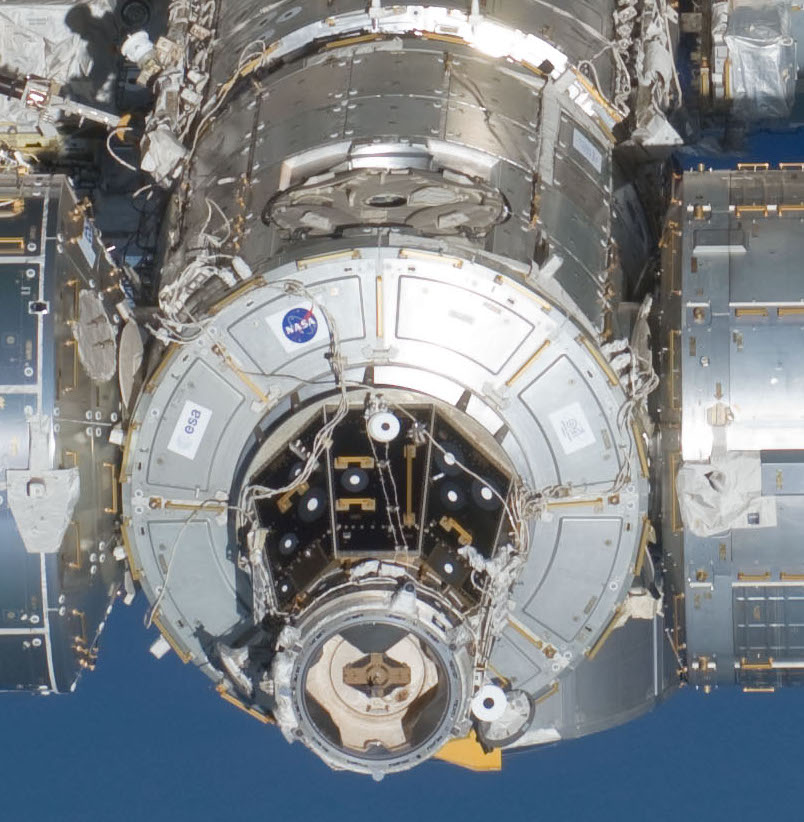
Harmony, formally designated Node 2, is a connecting pressurized module of the International Space Station (ISS) belonging to the United States Orbital Segment. Operated by NASA, it serves as one of the station's central structural and logistical junctions, linking several major laboratory modules to the station's main truss and habitable volume while simultaneously functioning as the primary gateway for crewed commercial spacecraft arriving from Earth. Launched in October 2007, Harmony has grown in operational importance over the decades since its installation, evolving from a passive connector into the busiest traffic hub on the station.
Purpose and Role
Within the architecture of the ISS, node modules occupy a role analogous to junction boxes in a complex building: they create branching pathways between major sections and consolidate utility routing so that individual laboratories and habitation modules do not each require independent connections to the station's backbone systems. Harmony fulfills this function at a particularly critical location, sitting at the intersection of the American, European, and Japanese laboratory segments.
On its port and starboard sides, Harmony provides the hard attachment points for two of the station's most scientifically productive facilities. The European Space Agency's Columbus laboratory extends from one side, while the Japan Aerospace Exploration Agency's Kibō complex — the largest single module on the station — attaches from the other. Without Harmony as an intermediary, neither of these facilities could integrate structurally or functionally with the rest of the station.
Beyond physical attachment, Harmony acts as a utility distribution hub. It routes electrical power, thermal control fluids, data, and communications between the station's truss-mounted power systems and the laboratories it supports. This behind-the-scenes plumbing and wiring role is less visible than the module's berthing and docking functions but is equally essential: the European and Japanese laboratories depend on Harmony's internal systems to receive power and maintain the environmental conditions necessary for scientific work.
At its forward end, Harmony has taken on a role that was not fully anticipated when it was designed: serving as the principal docking location for American commercial crew vehicles. International Docking Adapters installed at its forward port allow SpaceX Crew Dragon and Boeing Starliner spacecraft to berth directly with the station, making Harmony the literal threshold through which astronauts arriving on commercial vehicles step onto the ISS. This function positions the module at the center of the ongoing commercial crew era of human spaceflight.
The module also contains crew sleep stations — private, coffin-sized cabins where astronauts can rest, store personal items, and have a degree of acoustic and visual separation from the rest of the station. In a living environment where personal space is an extremely limited resource, these quarters carry a significance that extends beyond mere practicality.
Launch and Assembly
Harmony launched on 23 October 2007 aboard Space Shuttle Discovery during mission STS-120. The choice of Discovery for this flight continued that orbiter's long record of ISS assembly missions. The shuttle carried Harmony in its payload bay across the climb to low Earth orbit, where the ISS circles the planet at an inclination of approximately 51.6 degrees — a trajectory chosen specifically to be accessible from the launch sites of all partner nations.
STS-120 was a complex mission by any measure. The shuttle crew was tasked not only with delivering and installing Harmony but also with relocating the P6 solar array truss segment, and the mission included spacewalks to manage an unexpected tear in one of the station's solar array panels. The installation of Harmony itself required robotic arm operations and extravehicular activity to connect power, data, and fluid lines. Once berthed and its systems verified, Harmony became a permanent fixture of the station's structure.
Because Harmony is physically integrated into the station rather than operating as a free-flying spacecraft, it is not assigned its own entry in the NORAD satellite catalog. Instead, it is tracked as part of the ISS under NORAD identifier 25544, the catalog number assigned to the station as a whole. This is standard practice for attached ISS modules.
Inside the Module
Harmony's interior is organized around a central corridor with radial ports — openings in six directions that correspond to the six possible connection points of a node module's roughly cylindrical form. Not all ports are used in the same way or for the same purpose, but the arrangement gives the module its characteristic quality as a crossroads: moving through Harmony, a crew member might be transitioning between the American segment and the Japanese laboratory, or passing toward the forward docking port to greet an arriving crew.
The module's inner walls are lined with equipment racks that hold systems hardware — power distribution units, data management components, thermal control equipment — rather than the science payloads that fill the adjacent laboratories. This reflects Harmony's character as infrastructure rather than destination: it exists to make the surrounding science possible, not to conduct science directly. The utilitarian nature of the interior is tempered by the crew quarters, which give astronauts a personal retreat within the otherwise open, shared environment of the station.
Environmental systems within Harmony maintain the pressurized atmosphere at conditions suitable for continuous human habitation, consistent with the rest of the station's pressurized volume. The module is fully integrated into the station's life support network rather than operating independently, again reflecting its role as part of a larger whole.
Significance and Current Status
As of the time of writing, Harmony remains attached to the ISS and fully operational. Its longevity is itself notable: launched during the shuttle era, it has now been a continuous part of the station for well over a decade and a half, spanning the transition from shuttle-era assembly, through the years of Soyuz-dominated crew transport, and into the commercial crew period.
That last transition has arguably elevated Harmony's profile more than any other development since its installation. When crewed commercial spacecraft began regularly arriving at the station, Harmony's forward port became the most-watched docking location in low Earth orbit, the point at which new crews physically cross from their spacecraft into the station and where departing astronauts say their final goodbyes before undocking. The module that was originally conceived primarily as a structural connector and utility hub now also carries the symbolic weight of being the station's front door for American human spaceflight.
Within the broader context of ISS tracking and orbital observation — the purpose of a resource like LowEarth — Harmony is not independently observable. As noted, it is catalogued and tracked under the ISS entry. But understanding the internal geography of the station, and knowing which module sits where within that geography, adds meaning to any observation of the ISS as it crosses the sky. The bright point of light that constitutes a typical ground-based ISS sighting contains Harmony somewhere within it, quietly distributing power to Columbus, providing a berth to Kibō, and waiting at its forward port for the next crew to arrive.
Part of the International Space Station. The station is tracked as one object — track the ISS live.